
Our video search now has a published home on AMD and Supermicro hardware, and the footage never has to leave the building.
Most broadcasters don't have a storage problem anymore. They have a finding problem.
A petabyte of full-HD video at a typical 50 Mbps mezzanine bitrate is about 50,000 hours, close to 5.7 years of programming running around the clock. Somewhere in there is the shot a producer needs tonight. Whether anyone finds it usually depends on what a logger typed years ago.
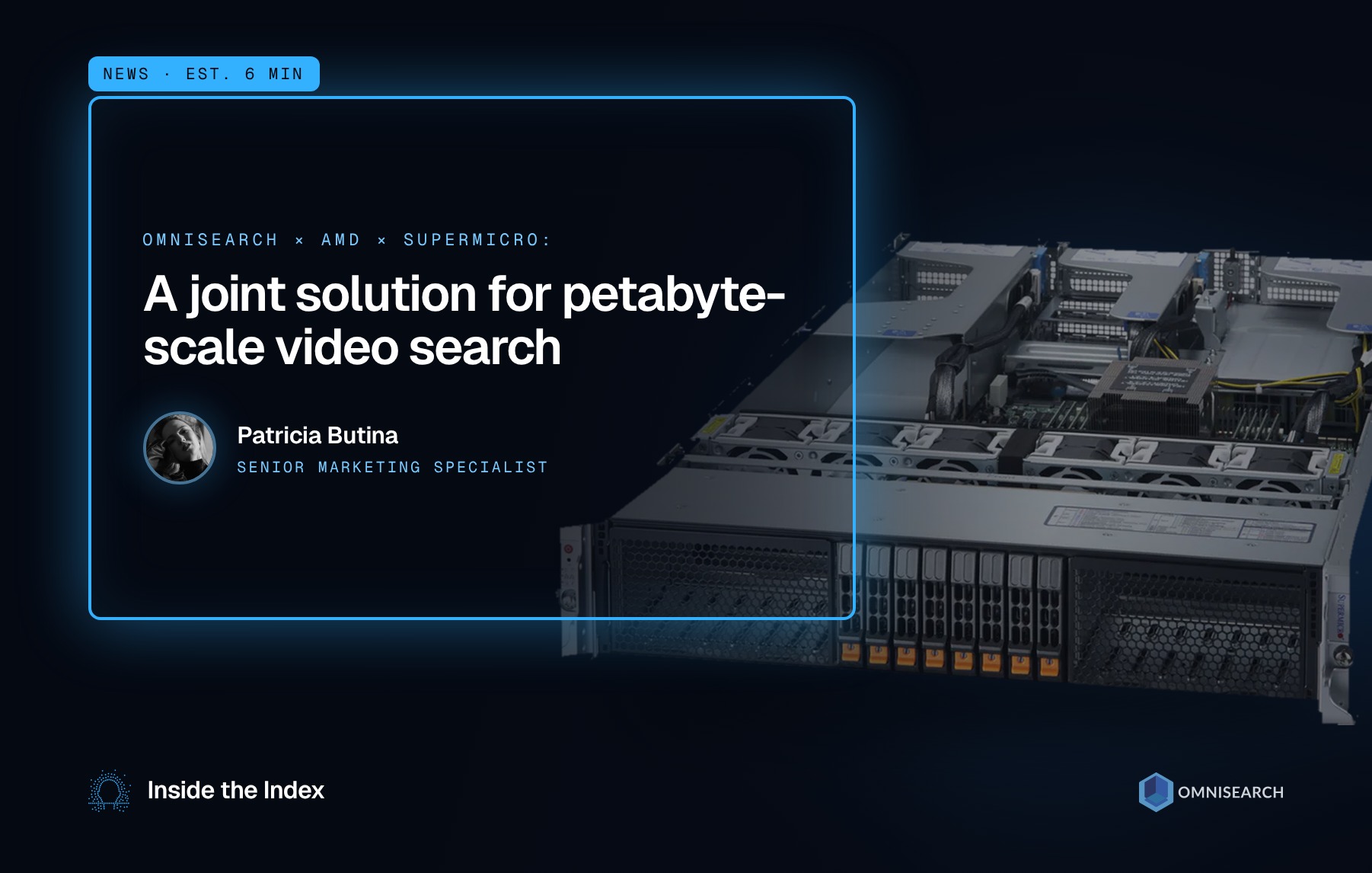
In November we published a joint solution brief with Supermicro and AMD that takes on that problem directly. It documents Omnisearch's multimodal video search running on AMD Ryzen Threadripper PRO and Radeon AI PRO hardware in a single Supermicro 2U workstation, on the customer's own premises.

Why archives stall
At petabyte scale, manual tagging can't keep pace with volume, and footage nobody described can't be found, licensed or reused. AI indexing helped, but most platforms have to reprocess the entire archive whenever their models are updated, and at tens of thousands of hours that becomes a recurring compute bill. Then there's security. For many studios and broadcasters, sending footage to a cloud service is ruled out by contract before any technical evaluation starts.
What's in the box
The reference configuration is short enough to list in full: a Supermicro AS-2115HV-TNRT 2U workstation, an AMD Ryzen Threadripper PRO 9975WX with 32 cores, two AMD Radeon AI PRO R9700 GPUs with 32 GB each, 128 GB of DDR5-6400, a 480 GB M.2 boot drive, 3.84 TB of U.2 NVMe and dual 10GbE.
Our software analyzes frames, audio and context together, picking up objects, people, faces, logos, activities, speech and scene changes, and turns them into one searchable index. AMD's GPUs do the heavy lifting that indexing requires: video decoding, AI inference and embedding generation. We chose the R9700 for its inference throughput at a lower acquisition and operating cost. Supermicro's workstation ties it together, with PCIe 5.0 and room to add GPUs.
In practice, an editor can type something like "flooded street, news crew, late 1990s" and get back moments, not filenames.
Index once, search forever
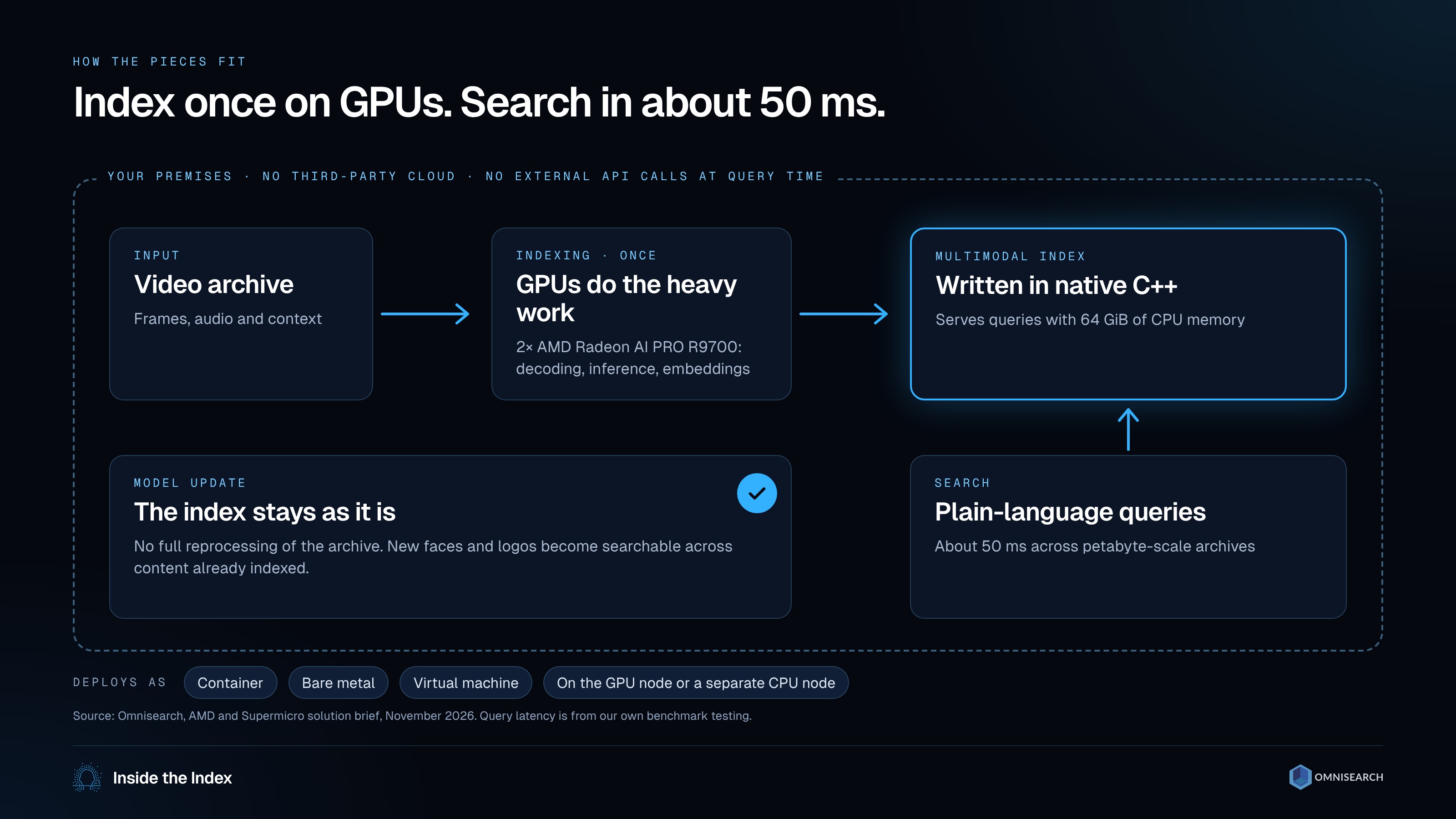
The architecture keeps indexing and search apart. Indexing is long, GPU-heavy and done once per hour of footage. Search is fast and light. Our index is written in native C++ and runs on 64 GiB of CPU memory.
We call that split Index Once, Search Forever. The index format doesn't change when the AI models improve, so an upgrade doesn't trigger a full reprocessing run. Faces and logos added later become searchable across everything already indexed.
All of it runs inside the customer's environment, with no third-party cloud dependencies and no external API calls at query time. Omnisearch deploys as a container, on bare metal or in a virtual machine, on the GPU node or on a separate CPU node.
What we measured

In our benchmark testing on August 13, 2026, query latency held under 50 ms across a full petabyte-scale, full-HD archive. That figure is search time, not indexing time, and it comes from our own testing. Any serious buyer should validate it on their own content, and we're glad to help them do it. On the indexing side, a single node can sustain continuous ingest at live-broadcast pace.
Our brief covers four uses: broadcast archive search, rights and talent management, post-production and content repurposing, and compliance and moderation. The buyers who fit share an archive too large to search by hand, content that has to stay on-premises, and a preference for owning infrastructure over renting it. News broadcasters, studios with deep libraries, sports rights holders and national archives all fit that picture.
Until now, buyers had to take our word for what Omnisearch needs to run. Now the parts list is public, with Supermicro and AMD names on it. An infrastructure team can get a quote for it and plan a pilot around it.
The full brief, with the complete configuration and use cases, is on Supermicro's website.
Read the joint solution brief · Book a demo