Omnisearch: The Backbone of Real Video Search

Patricia Butina
Marketing Specialist
Published:
December 31, 2025
Topic:
Insights

Video now drives the majority of media consumption. The pace is relentless. Streaming dominates viewing habits, and content teams are producing more footage each week than they did over entire quarters just a few years ago. In production studios, newsrooms, sports networks, and streaming services, video archives are growing at breakneck speed.
This explosion of footage should be a strategic advantage. In reality, it has created a bottleneck. The issue isn't how much content exists, but how difficult it is to find the right clip when it matters. Teams know they’ve captured valuable material, but retrieving it is slow, painful, and often guesswork.
The problem has never been about storing footage. It’s about accessing it.

What Real Video Search Should Have Been
Most search tools still rely on basic metadata, filenames, and folder structures. Some index transcripts. A few add basic facial recognition. But when a producer needs to locate a specific take, or an editor is working against deadline, these systems usually fall short. Search tools return broad matches, not precision. They find content that’s similar, not exact.
Production doesn’t run on “close enough.” You either have the right shot or you don’t. Guessing costs time. Scrubbing costs more. Teams end up rewatching hours of material, or worse, reshooting something that already exists because no one could find it in time.
Omnisearch was built to eliminate this waste. It indexes the actual content of your videos, not just the file-level information around them. It understands spoken dialogue, identifies people on screen, reads on-screen text, detects visual elements, and interprets context. You don’t need to tag anything manually. You simply search for what you remember, and Omnisearch shows you exactly where that moment exists in your footage. No scrubbing, no second-guessing.

How It Works in Film Production
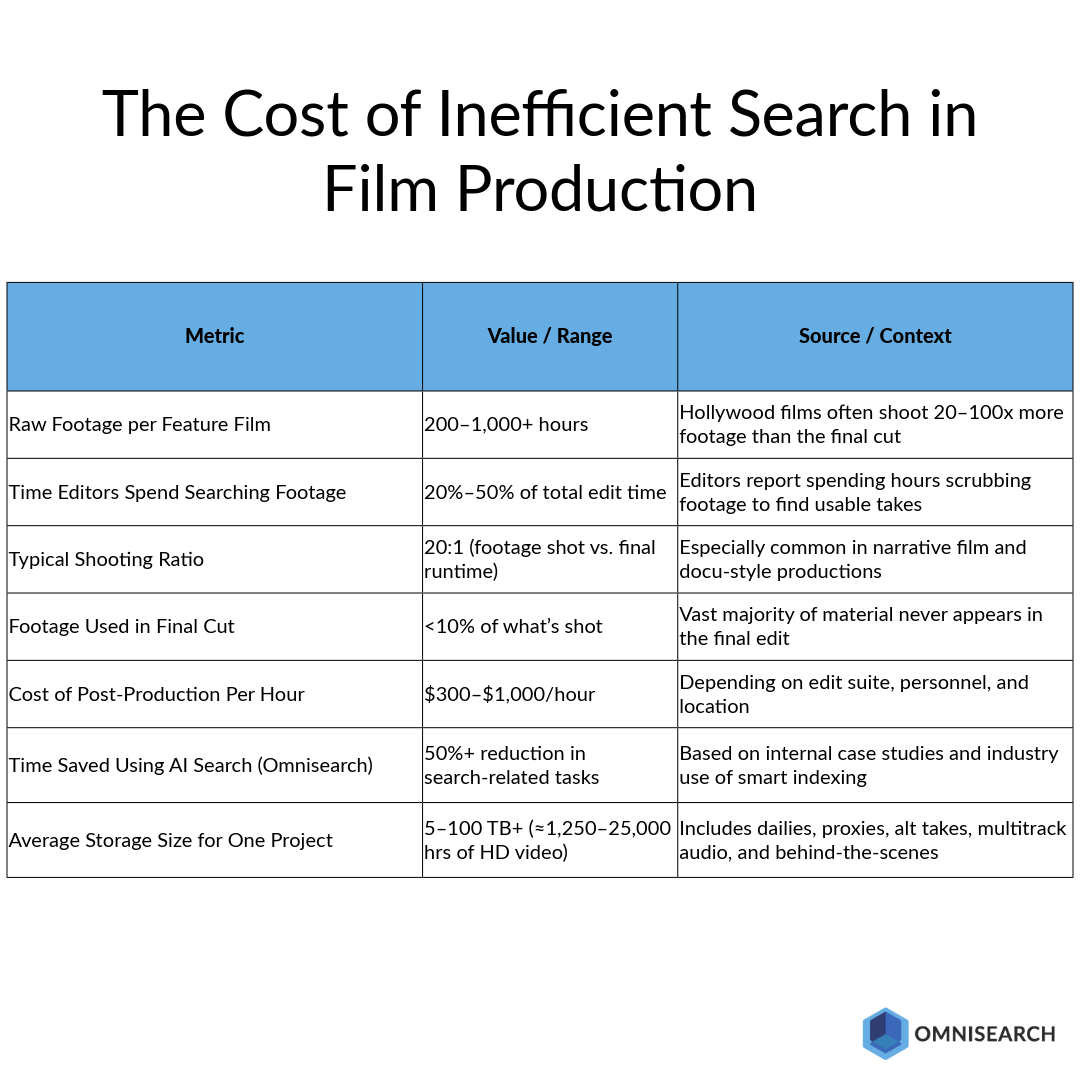
Film production is chaotic by nature. Shoots involve multiple cameras, alternate takes, overlapping versions, and evolving naming conventions. Media often gets saved out of order, mislabeled, or archived before anyone logs it fully.
That’s where most teams start losing time. Editors waste hours trying to track down a specific version of a scene. Assistants are stuck digging through external drives or asking around about a forgotten filename. Omnisearch removes that dependency completely.
With Omnisearch, a team can instantly find every take where a specific line was delivered, or where a certain actor enters frame from a specific angle. Trailers can be built from untagged footage. Archived B-roll can be located in minutes. Post-production moves faster, and reshoots are avoided simply because people are able to use what’s already been captured.
How It Works in News
News organizations have some of the richest video archives in media, but those archives are rarely easy to use. Teams rely on memory, legacy folder structures, or limited catalog systems that haven’t kept up with the growth of their libraries.
Omnisearch changes that by giving producers the ability to search their footage by content. They don’t need to know the clip title or who originally logged it. They just describe what they’re looking for, and the system returns exact results — not vague suggestions, but timestamped matches with full preview access.
This capability transforms how newsrooms operate. Instead of spending hours pulling together archival footage for a package, editors can find the right clips in minutes. That time savings means more stories get told, more historical context gets included, and teams can respond faster to breaking news. The archive becomes a tool, not a burden.
.png)
How It Works in Streaming
Streaming platforms live and die by content discovery. Success depends on helping viewers find the right content at the right time. That means recommendation systems need more than genre tags and title-level data. They need to understand what’s inside each scene.
Omnisearch enables this by analyzing every frame of every asset. It recognizes tone, dialogue, visuals, objects, and location. That information becomes metadata. It feeds discovery, drives personalization, and enables advanced editorial workflows like automatic trailer generation or targeted clip creation.
This also helps unlock the long tail of the catalog. Older content becomes searchable at the same level as new releases. A holiday episode from 2014 can be pulled into a current marketing campaign because it features the right setting. A one-liner from a forgotten show can be clipped and repackaged as promotional material. Teams no longer rely on memory or chance to resurface valuable material. The entire library becomes usable.
.png)
Why Omnisearch Works When Others Don’t
Most tools in this space either require heavy manual tagging, deliver generic results, or integrate poorly with real workflows. Omnisearch avoids all three of those traps.
It works on real production footage, including rough cuts, multilingual content, overlapping audio, and unstructured media. It doesn’t rely on perfect inputs. It handles messy data because that’s what most media libraries are full of. It integrates through APIs, dashboards, or directly into asset managers. It does not force you to change how your team works, it just makes your existing process faster and more reliable.
The search experience is immediate. You get results in seconds, with precise matches and full context.
A Better Way to Use the Content You Already Own
Every company in this industry has valuable footage sitting on a drive somewhere. Omnisearch turns that footage into an active asset.
The system gives teams the ability to search their video libraries like they search the web — with context, clarity, and speed. It removes the friction that slows down creative and operational work. It cuts out wasted hours and makes better use of what you already have.